The strip of street outside 245–247 Tai Kok Tsui Road
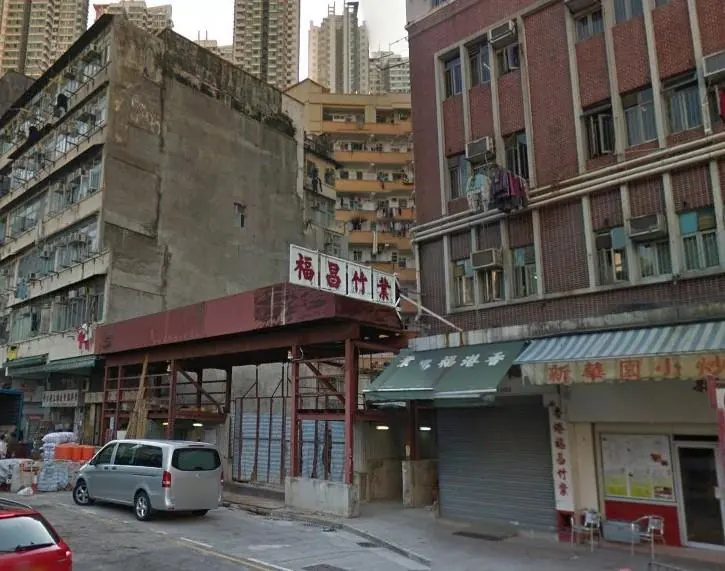
Seen from across Tai Kok Tsui Road, the red hoarding and temporary canopy sit between neighbouring buildings. The street and the site frontage are recognisable, although the underground elements are outside the camera’s view. Pages 78 and 87–88 identify piling and foundation works at Nos. 245–247 in 2014–2015. The photograph gives a visitor the way to the site. The written record supplies the commission behind the hoarding. For a similar urban site meeting, an owner could identify the entrance street, adjoining buildings and the drawing that defines the existing site boundary. Including those details in the appointment gives the people attending a common point of departure.
Milton company profile, 2025, pp. 78 and 87–88.
Beach Road from above and from the toe
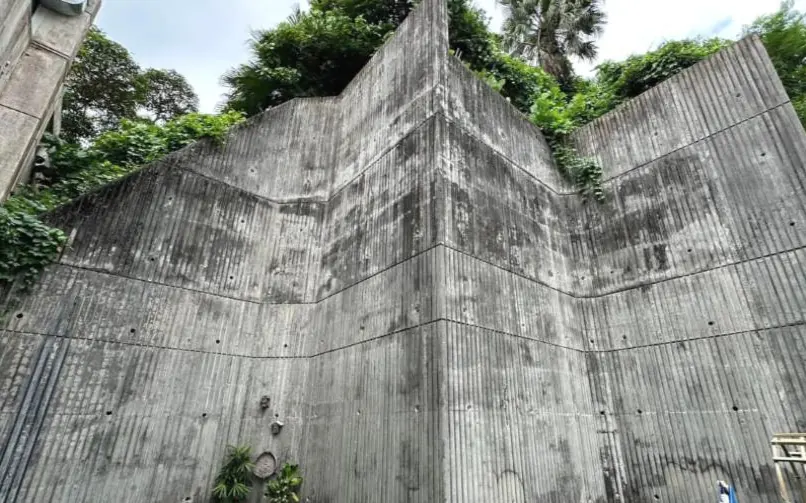
At Beach Road in Repulse Bay the same setting is read from two heights. Looking down, the camera records parallel lines across a concrete slope and patches of vegetation. Looking up from the base, it records the height of the face beside a play area. Page 191 identifies slope refurbishment beginning in 2024, listed as under way in the 2025 profile. The paired viewpoints show which part adjoins a space used by the public. An owner making an enquiry can mark the crest, face or toe on a location plan and identify the safe point from which a photograph was taken. The relevant qualified professionals can then assess any question about condition against the site and technical records.
Milton company profile, 2025, pp. 77 and 191.
A narrow opening at 58 Stanley Village Road
At 58 Stanley Village Road the view returns to pavement level. Drain replacement and refurbishment are recorded for 2024–2025. Photographs show a narrow excavation running along the roadside, plant, temporary cones and a closer view into the open section where work was taking place. Once reinstated, the surface carries only limited clues to the line below, which gives a general view with fixed references particular value. A handover sketch for a similar job could identify the limits by two meaningful endpoints, show which one the photographer stood near, and link that orientation to the record drawing. The section can then be traced when the road is back in use.
Milton company profile, 2025, pp. 77 and 205.
Choosing a question that the view can support
The hoarding suggests a question about access and the site boundary. The slope invites the observer to say whether the view comes from above or below, and which part neighbours a facility in use. The open drain calls for the direction of the line relative to the road and a durable street feature by which it can be recovered. These are different questions for different plans and attending parties. Where a fact is still to be established, record the observation in plain language, such as a hoarding at this frontage, a play area beside this slope or a trench following this kerb. Pile positions, underlying ground conditions and underground connections can then be checked in the appropriate design or survey record.
Read together, Milton company profile, pp. 87–88, 191 and 205. Site-visit questions are examples for owners.
Which landmark will survive the works?
Features that are striking in a work photograph may themselves disappear. The temporary canopy at a street frontage can come down, a concrete slope changes colour with weather and time, and traffic cones leave the roadside after reinstatement. Recording an adjoining property, the direction of the street or a fixed entrance alongside these temporary features ties a moment during construction to a setting that may still be recognisable years later. A short site note can describe what was visible on the day and explain how a colleague could find the same point on a later visit. The first preserves an observation. The second gives someone who was absent a practical route back.
Site settings and construction photographs in Milton company profile, pp. 87–88, 191 and 205.